Infrastructure Architecture Shaped by Industry Requirements
Novatelia publishes nine industry blueprints: enterprise campuses, government, healthcare, energy, retail, logistics, maritime, banking, and education. Each page explains the operating environment and the engineering questions that follow from it.
Industry blueprints describe operating requirements and architecture considerations. They are not completed customer case studies.
Requirement blueprints for nine published sectors. These pages describe operating context. They are not a list of customer wins.
Find the Infrastructure Blueprint for Your Industry
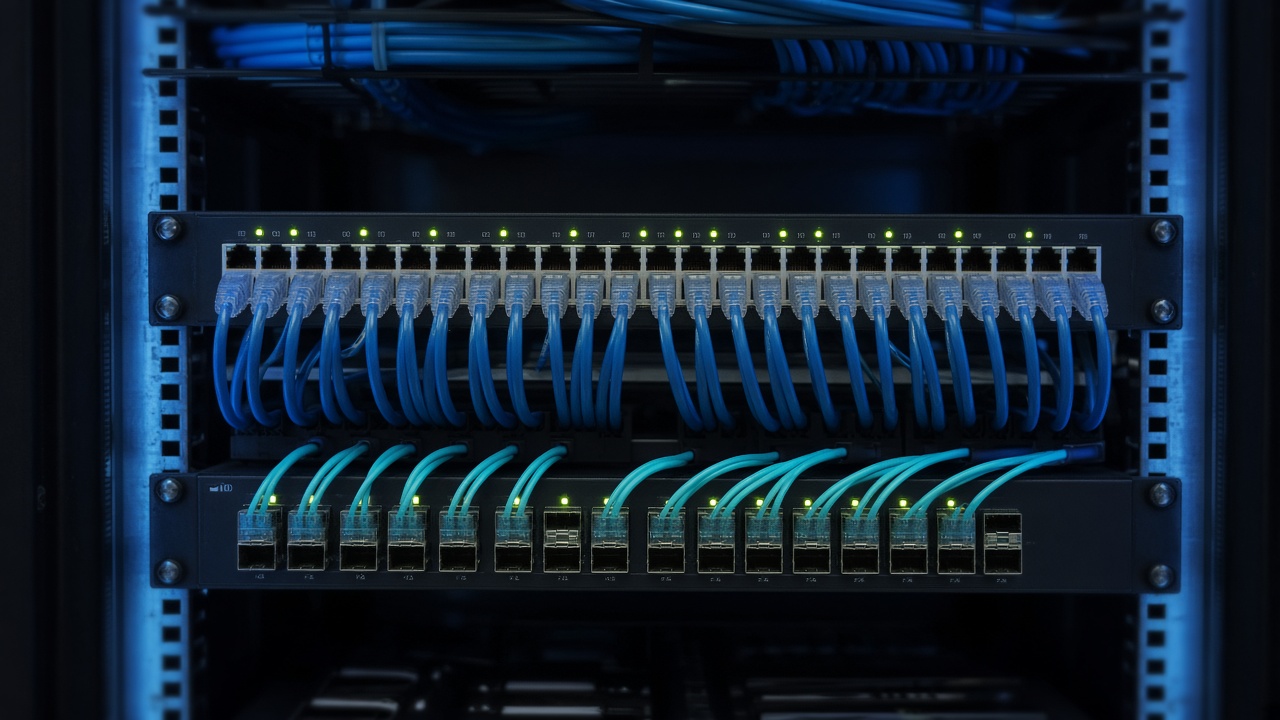
Choose a sector. The photograph, the published summary, and the three operating constraints stay in the page HTML either way.
Campus LAN, SD-WAN, and collaboration
Enterprise & Corporate Campuses
High-availability campus LANs, secure multi-branch SD-WAN, and executive collaboration spaces.
Managing high-density wireless environments across executive floors and meeting rooms
Enforcing strict zero-trust network access (ZTNA) across corporate and BYOD devices
Maintaining 99.999% uptime for cloud ERP and VoIP communications
The published 99.999% uptime figure is an operating requirement from the source record. It is not a Novatelia availability guarantee.
Imaging connectivity, segmentation, and RF coexistence
Healthcare & Medical Centers
Continuous connectivity for PACS medical imaging, mobile telemetry, and patient IoT isolation.
High-bandwidth transfer requirements for uncompressed DICOM medical images
Strict isolation between clinical life-support VLANs and patient guest Wi-Fi
Zero radio interference with sensitive medical diagnostics hardware
Continuous connectivity and zero radio interference are source wording. They are not a clinical-availability or interference-free guarantee, and this page is not a sector certification.
High ambient desert temperatures (-10°C to +70°C) requiring fanless industrial hardware
Securing legacy SCADA / Modbus telemetry from external cyber threats
Long-distance single-mode fiber runs exceeding 80 kilometers between substations
The −10°C to +70°C range and fiber paths beyond 80 km stay in the source record. Equipment ratings and optical reach depend on the site specification and a real link budget.
Branch consistency, payment segmentation, and guest access
Retail & Multi-Branch Distribution
Standardized branch network rollouts, PCI-DSS compliant POS networks, and central cloud visibility.
Rapid deployment across multiple store locations with consistent configuration
Protecting point-of-sale payment terminals from unauthorized access
Providing customer guest Wi-Fi with social login and marketing telemetry
PCI-DSS compliant POS networks is the original summary. It describes design requirements for payment environments. It is not an independent PCI DSS certification.
Yard wireless, device roaming, and perimeter video
Transport, Ports & Logistics Hubs
High-density warehouse Wi-Fi, port terminal outdoor wireless, and long-range perimeter CCTV.
Overcoming metal container stacking and RF reflection in large logistics yards
Seamless roaming for forklift-mounted barcode scanners and handheld terminals
Perimeter surveillance integration across expansive coastal port terminals
Seamless roaming is the requested mobility outcome. Roaming quality depends on clients, RF conditions, and validation. This page is not a port-authority approval.
High-frequency secure transaction processing with zero tolerance for packet loss
Stringent segregation between customer banking networks, swift gateways, and administrative subnets
Rigorous audit log retention and continuous privileged session recording
Zero tolerance for packet loss and continuous privileged-session recording are potential requirements. They are not measured results, and this page is not a banking-regulator accreditation. SWIFT is a separately governed messaging boundary where it applies.
Imaging connectivity, segmentation, and RF coexistence
Continuous connectivity for PACS medical imaging, mobile telemetry, and patient IoT isolation.
High-bandwidth transfer requirements for uncompressed DICOM medical images
Strict isolation between clinical life-support VLANs and patient guest Wi-Fi
Zero radio interference with sensitive medical diagnostics hardware
Continuous connectivity and zero radio interference are source wording. They are not a clinical-availability or interference-free guarantee, and this page is not a sector certification.
High ambient desert temperatures (-10°C to +70°C) requiring fanless industrial hardware
Securing legacy SCADA / Modbus telemetry from external cyber threats
Long-distance single-mode fiber runs exceeding 80 kilometers between substations
The −10°C to +70°C range and fiber paths beyond 80 km stay in the source record. Equipment ratings and optical reach depend on the site specification and a real link budget.
Branch consistency, payment segmentation, and guest access
Standardized branch network rollouts, PCI-DSS compliant POS networks, and central cloud visibility.
Rapid deployment across multiple store locations with consistent configuration
Protecting point-of-sale payment terminals from unauthorized access
Providing customer guest Wi-Fi with social login and marketing telemetry
PCI-DSS compliant POS networks is the original summary. It describes design requirements for payment environments. It is not an independent PCI DSS certification.
Yard wireless, device roaming, and perimeter video
High-density warehouse Wi-Fi, port terminal outdoor wireless, and long-range perimeter CCTV.
Overcoming metal container stacking and RF reflection in large logistics yards
Seamless roaming for forklift-mounted barcode scanners and handheld terminals
Perimeter surveillance integration across expansive coastal port terminals
Seamless roaming is the requested mobility outcome. Roaming quality depends on clients, RF conditions, and validation. This page is not a port-authority approval.
High-frequency secure transaction processing with zero tolerance for packet loss
Stringent segregation between customer banking networks, swift gateways, and administrative subnets
Rigorous audit log retention and continuous privileged session recording
Zero tolerance for packet loss and continuous privileged-session recording are potential requirements. They are not measured results, and this page is not a banking-regulator accreditation. SWIFT is a separately governed messaging boundary where it applies.
Agreed tests and records. A method name is not a pass result.
From Operating Context to a Defined Engineering Scope
These five stages explain how a conversation can move from context to a scope. They are not a fixed contract process and they do not report project metrics.
01
Understand the industry operating environment
Start from the sector’s sites, users, and the constraints already published on the blueprint.
02
Identify availability, security and connectivity requirements
Separate what the organization needs from what a design can later be shown to deliver.
03
Review architecture and system dependencies
Applications, identity, cabling, wireless, and operations each add dependencies. Not every dependency is in scope.
04
Define a suitable technical approach
The approach names technologies only where they fit the requirements. It is not a bill of materials yet.
05
Validate the proposed scope before implementation
Validation criteria belong in the approved scope. A diagram is not evidence that the work is finished.
Infrastructure Planning for Organizations in Oman and the GCC
Novatelia’s published desk is in Muscat. Site conditions, applicable requirements, and deployment circumstances differ among industries and locations. Heat, dust, coastal air, import timing, and the rules of a specific ministry or operator all change the design.
This page does not describe a completed country-wide program, a government framework award, an office in every GCC state, a regional certification, or a guaranteed site-response time.
Engineering Blueprints, Not Claims of Completed Projects
The published industry pages describe industry context, typical operating constraints, architecture considerations, related engineering disciplines, and scope-dependent opportunities.
They do not themselves establish completed customer projects, certifications, client references, SLA achievements, or measured performance results.
Connect Industry Requirements to Engineering Services
Technology Solutions by Industry — Questions and Answers
01
What are industry-specific technology solutions?
They are architecture blueprints. Each one describes the operating environment, typical constraints, and engineering disciplines for one sector. They are not completed customer projects.
02
Which industries does Novatelia publish blueprints for?
Nine: Enterprise and Corporate Campuses, Government and Public Sector, Healthcare and Medical Centers, Oil Gas and Energy Infrastructure, Retail and Multi-Branch Distribution, Transport Ports and Logistics Hubs, Maritime Shipping and Offshore Technology, Banking and Financial Services, and Education and Academic Campuses.
03
How does enterprise campus networking differ from industrial networking?
A corporate campus is built around offices, wireless density, identity, and business applications. An energy site adds harsh environments, industrial Ethernet, and OT boundaries such as SCADA or Modbus. The topologies are not interchangeable.
04
Why do government networks require different security considerations?
Some government systems need physical separation between sensitive and administrative environments. A VLAN is not an air gap. Tender traceability and contract support terms also shape the work.
05
What networking considerations matter in healthcare environments?
Imaging workflows such as PACS and DICOM, separation of clinical and guest networks, and radio coexistence with medical equipment. A VLAN is not sufficient isolation for every device, and Novatelia does not certify medical equipment.
06
How are oil and gas network environments different?
They combine industrial Ethernet, long fiber routes, and OT segmentation. A temperature range or an 80 km path in the source record is a requirement to engineer, not a universal product rating or a guaranteed optical reach.
07
What matters when connecting multiple retail branches?
A repeatable branch design, separation of POS payment paths from guest Wi-Fi, and a WAN or SD-WAN choice that fits the carrier and the applications. Segmentation does not by itself mean PCI DSS certification.
08
Why is wireless engineering difficult in container yards?
Metal stacks obstruct and reflect radio signals, and the stacks move. Roaming for scanners depends on the client, the RF plan, and a site test. Illustrations on these pages are not measured surveys.
09
What network security considerations affect financial institutions?
Transaction connectivity, separation of banking, SWIFT-related, and administrative systems, plus logging and privileged-access governance. Zero packet loss and continuous session recording are requirements to evaluate, not results this page claims.
10
How are educational networks designed for BYOD?
Personal student devices and institution-owned lab machines need different access policies. Research and administrative systems can sit on separate paths. Device counts come from the institution, not from a Novatelia deployment claim.
11
Does an industry blueprint represent a completed project?
No. Industry blueprints describe operating requirements and architecture considerations. They are not completed customer case studies, client references, or measured performance results.
12
Does Novatelia guarantee 99.999% uptime?
No. The figure appears in the enterprise source record as an ambitious availability requirement for cloud ERP and VoIP. It is not a contracted or measured Novatelia outcome.
13
Can industry solutions involve multiple Novatelia service disciplines?
Yes, when the scope says so. Design, cabling, security architecture, surveillance, assessment, and testing are separate services. None of them is automatically included in every blueprint.
14
How can an organization request an industry-specific architecture review?
Open the RFQ draft or contact the Muscat desk. The RFQ page keeps a browser draft. It does not submit a quotation or issue a reference.
Explore the Blueprint That Matches Your Infrastructure Requirements
The RFQ page keeps a browser draft. It does not submit a quotation or issue a reference.