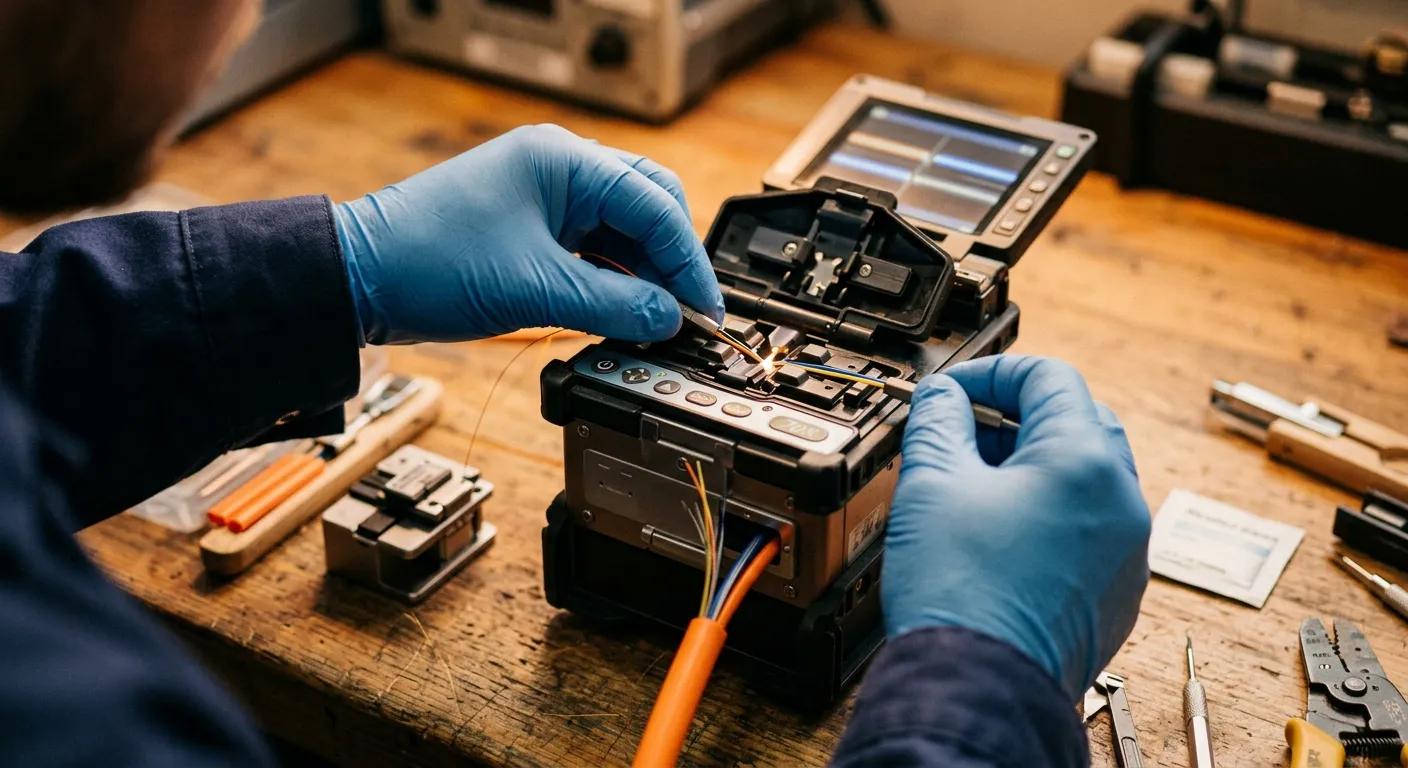
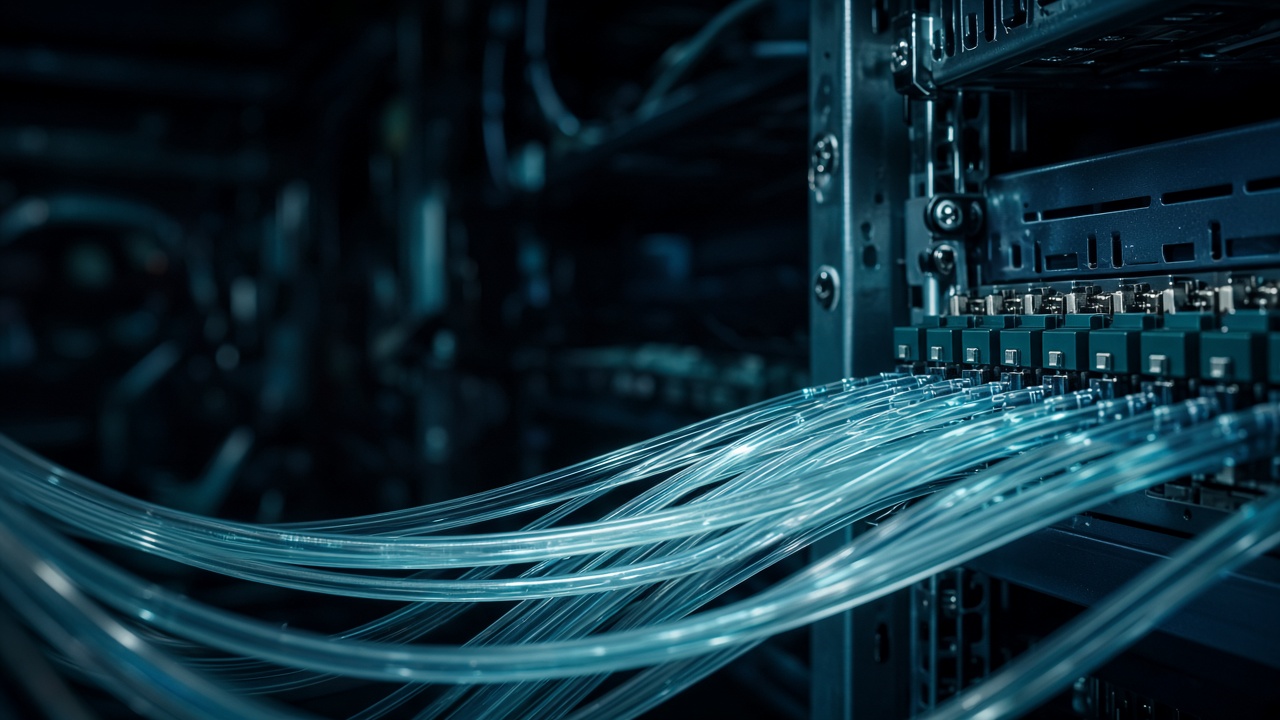
These eight cards are working notes. The formula-article routes stay on their existing index setting. This index page is not marked noindex because the cards are notes. A card is not a certified design, and a formula does not replace a measurement.
KB-001 · fiber · 6 min
Choose Fiber from the Complete Link Requirement
Passive channel loss is one input to an optical link. It is not the whole transceiver decision.
Channel loss (dB) = fiber attenuation (dB/km) × distance (km) + splice losses (dB) + connector-pair losses (dB).
Units. Attenuation in dB/km, distance in km, each splice and connector pair in dB.
Assumptions. Use the fiber type, wavelength, and the attenuation that applies to that fiber. Count the connectors and splices on the path. Then compare the result with the transmitter output, receiver sensitivity, receiver overload, the required rate, and a margin the project sets. OS2, OM4, and OM5 are different fibers. A fiber name alone does not set a distance.
Open KB-001KB-002 · poe · 5 min
Check the PoE Standard and the Whole Switch Power Budget
PoE needs the device demand, the class the PSE grants, and the switch budget that can be on at the same time.
Compare each device demand with the power the PSE reserves for that class, then add the simultaneous load and compare it with the switch PoE budget.
Units. Watts at the PSE and watts available at the powered device. IEEE 802.3af, 802.3at, and 802.3bt name different class limits.
Assumptions. A manufacturer-rated PoE budget is not divided again by 0.85. That second derating double-counts loss when the published budget is already the power the supply can deliver. Per-port limits, redundancy, and the number of devices drawing power together still have to be checked.
Open KB-002KB-003 · switching · 6 min
Select Uplinks from Traffic and Resilience Requirements
An oversubscription ratio is a planning indicator made from nominal port speeds.
Planning ratio = (downlink count × downlink speed) : (usable uplink capacity in the failure case being studied).
Units. Speeds in the same unit, such as Gbit/s. The ratio is dimensionless.
Assumptions. Nominal capacity is not offered traffic and is not proof of congestion. LACP can add member links for different flows. It does not give every individual flow the combined rate of all members. EVPN-VXLAN is one architecture, not a requirement for every uplink.
Open KB-003KB-004 · cctv · 5 min
Estimate CCTV Storage with Explicit Units & Parameters
A storage estimate needs an average bitrate, a retention period, and a statement of what “usable” means.
Archive bytes ≈ camera count × average bitrate (bit/s) × seconds per day × retention days × duty cycle ÷ 8.
Units. Bitrate in bit/s or Mbit/s, with the conversion written down. Decimal TB is 10^12 bytes. Binary TiB is 2^40 bytes.
Assumptions. Average bitrate is not peak bitrate. A motion or schedule fraction is not a universal correction for every variable-bitrate camera. Codec, resolution, audio, metadata, and overhead change the stream. Raw disk capacity is not usable capacity after RAID, formatting, and spare policy.
Open KB-004KB-005 · cabling · 7 min
Specify the Complete Copper Cabling Channel
A copper channel is the permanent link plus the cords and connectors that complete it.
For the relevant balanced twisted-pair channel model: permanent link up to 90 m, channel up to 100 m, including the patch cords.
Units. Metres of cable, for the configuration the cited cabling standard actually covers.
Assumptions. Those lengths are not the maximum of every copper Ethernet application. Category, alien crosstalk, temperature, and the application standard can change the limit. Cat6A is a cable and connector grade, not a guarantee that any 90 m run will pass.
Open KB-005KB-006 · transceiver · 6 min
Confirm the Host Platform, Module & Optical Path
A module has to match the host, the coding the host enforces, and the optical path to the far end.
Check host acceptance, wavelength, fiber type, connector, transmit power, receiver sensitivity, and the receiver’s maximum input.
Units. Optical power in dBm. Attenuation in dB.
Assumptions. An overload specification is not automatically a damage threshold. Exceeding the maximum operational input can overload the receiver and can risk damage, depending on the module. No attenuator value is stated here, because that number needs both datasheets. DOM readings do not by themselves name the cause of a fault.
Open KB-006KB-007 · power · 5 min
Size UPS Capacity and Runtime Separately
UPS capacity and battery runtime are separate calculations.
Real power (W) = apparent power (VA) × power factor.
Units. Watts, volt-amperes, and a dimensionless power factor. Runtime is hours or minutes from battery energy, not from VA.
Assumptions. Power factor converts VA to watts for the load being served. It does not produce a runtime. Runtime depends on usable battery energy, efficiency, chemistry, age, temperature, and the redundancy the design requires.
Open KB-007KB-008 · wireless · 6 min
Plan a Wireless Upgrade from Clients and Site Conditions
Free-space path loss is a propagation model for an unobstructed path, not a survey of a building.
FSPL (dB) = 20 log10(distance in metres) + 20 log10(frequency in MHz) − 27.55.
Units. Distance in metres, frequency in MHz, result in dB. The constant 27.55 belongs to that pair of units.
Assumptions. Walls, multipath, interference, client radios, regulatory power and channel rules, antenna pattern, capacity, the wired uplink, and PoE are outside this equation. Wi-Fi 6E and Wi-Fi 7 are not assumed to be approved on every band and power mode in every jurisdiction.
Open KB-008